

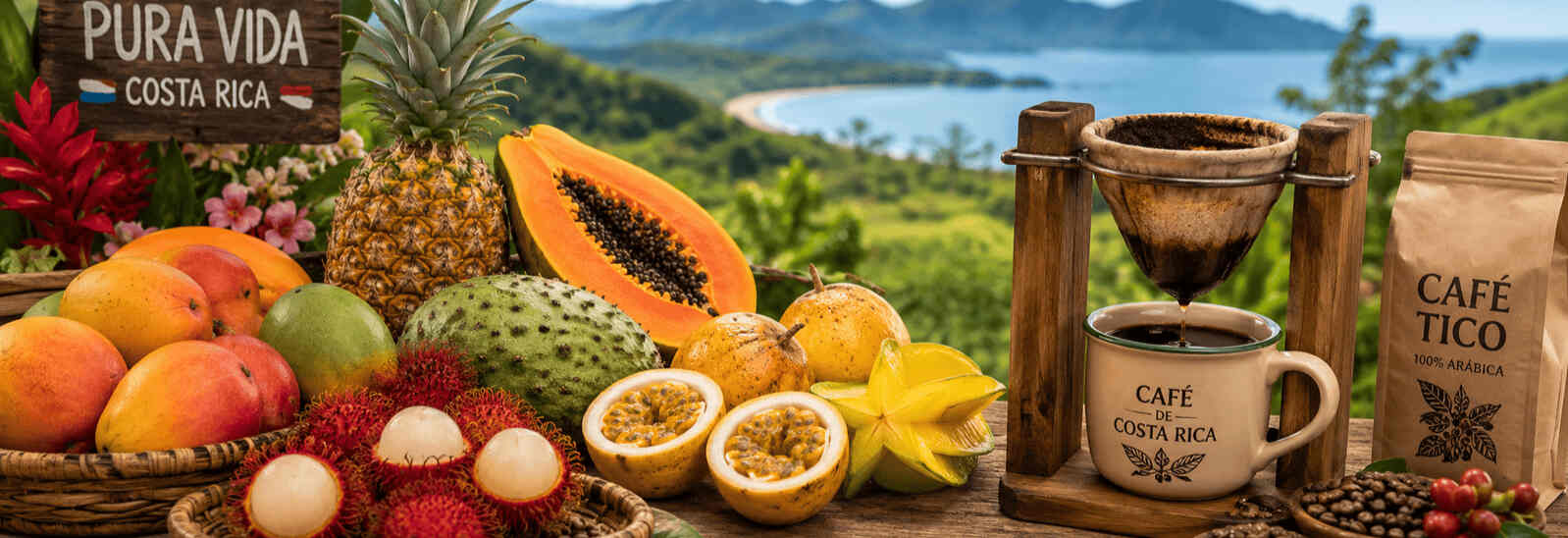
Costa Rica is a country you can taste as much as see. Tropical fruit grows in extraordinary variety, weekly farmers markets overflow with produce, roadside stands appear along rural highways, and coffee remains deeply woven into the country’s history and everyday routines.
For visitors and new residents, exploring Costa Rica through food is surprisingly easy. Start with a ripe mango from a roadside stand, order a maracuyá batido at a local soda, walk through a weekend feria, or brew locally roasted coffee through a traditional chorreador.
In this guide: Discover Costa Rica’s must-try tropical fruits, how to shop at a feria, what fruit seasonality really means, the country’s coffee-growing regions, washed vs. honey vs. natural processing, and how to buy a better bag of Costa Rican coffee.
Why Fruit Is Such a Big Part of Everyday Life in Costa Rica
Costa Rica’s combination of tropical temperatures, different elevations, distinct wet and dry seasons, and varied microclimates allows an impressive range of fruit to be grown.
Some fruits are familiar to North American visitors but taste noticeably different when harvested closer to ripeness. Others may be completely new. A supermarket mango eaten thousands of miles from where it was grown is a very different experience from buying several ripe mangoes during peak season in Costa Rica.
Fruit appears everywhere in daily life. It is served at breakfast, blended into drinks, sold beside highways, offered at farmers markets, turned into desserts and preserves, and sometimes eaten simply with lime and a pinch of salt.
Food shopping is also one of those everyday expenses that visitors rarely think about but residents quickly learn to understand. If you are considering living here, our guide to the true cost of living in Costa Rica looks at the broader household expenses involved.
Must-Try Fruits in Costa Rica
🥭 Mango
Sweet, fragrant and juicy when ripe. Less-ripe mango is also popular with salt, lime or seasonings. It works beautifully in batidos, fruit salads and desserts.
🍍 Piña — Pineapple
Widely available and especially memorable when eaten close to where it was grown. Costa Rican pineapple is commonly enjoyed fresh or blended into tropical drinks.
Papaya
A classic breakfast fruit with soft texture and mild sweetness. It pairs well with lime, yogurt and other tropical fruit.
Maracuyá
Passion fruit has an intensely aromatic, tart interior and is especially good in juices, batidos, cocktails and desserts.
Guanábana
Soursop has creamy white flesh with a sweet-tart flavor. It is particularly popular in smoothies and fresh drinks.
Mamón Chino
Known elsewhere as rambutan, this striking red fruit has a translucent, juicy interior with a mild sweetness similar to lychee.
Pejibaye — Peach Palm Fruit
Pejibaye is an important reminder that not every tropical fruit is sweet. The fruit of the peach palm is normally cooked before eating and has a dense, starchy texture.
A traditional simple preparation is boiled pejibaye served with mayonnaise. The flavor can remind newcomers more of squash, chestnut or sweet potato than mango or pineapple.
Try something different: If you see pejibaye at a market or soda, do not expect a juicy tropical fruit. Think savory, filling and slightly nutty instead.
Carambola — Starfruit
Slice a carambola crosswise and you immediately see where the English name comes from. The crisp, juicy slices form small stars.
The flavor can range from fairly tart to mildly sweet depending on ripeness and variety. It is eaten fresh and also used in juices and garnishes.
Bananas and Plantains
Bananas and plantains deserve separate mention because they play very different roles in Costa Rican cooking. Sweet bananas are eaten as fruit, while plantains are generally cooked.
Ripe plantains become sweet and caramelized when fried and frequently appear as a side dish. Green plantains can be fried and flattened into patacones, which are commonly served as an appetizer or accompaniment.
If you want to go beyond fruit and explore gallo pinto, casados, ceviche, patacones and other local favorites, see our complete guide to traditional Costa Rican cuisine.
When Is Fruit in Season in Costa Rica?
Fruit seasonality in Costa Rica is more complicated than a rigid month-by-month calendar. Rainfall, elevation, region, variety and individual growing conditions can shift harvest periods. Some crops are also commercially produced across long seasons or throughout much of the year.
Seasonality at a Glance
- Mango: especially abundant during the first half of the year.
- Mamón chino: more strongly associated with the later rainy-season months.
- Pineapple: commonly available across much of the year.
- Papaya: widely available for long periods.
- Bananas: one of the easiest fruits to find consistently.
The best seasonal calendar is often the feria itself. When a fruit suddenly appears in huge quantities and prices become attractive, you have probably found it near its local peak.
That is one reason residents quickly learn to shop seasonally instead of insisting on the same produce every week.
Shopping for Fruit at a Costa Rican Feria
A feria del agricultor, or farmers market, is one of the best places to understand Costa Rican food culture. Depending on the market, you may find fruits and vegetables alongside eggs, cheeses, baked goods, herbs, flowers, prepared foods and other locally produced items.
The feria is not simply a cheaper version of a supermarket. It is a social experience. Regular customers develop relationships with particular vendors, ask what is best that week and adjust their shopping around what has just been harvested.
🧺 Tips for Your First Feria Visit
- Bring reusable bags. Fruit gets heavy surprisingly quickly.
- Carry some cash in colones. Payment options vary by vendor.
- Go earlier for selection. Popular items can sell out.
- Ask when fruit will be ready. “¿Para hoy?” is an easy way to ask for something ripe enough to eat today.
- Buy seasonally. Abundant produce is often both better and better value.
- Try something unfamiliar. Ask the vendor what it is and how Costa Ricans normally eat it.
Batidos, Frescos and Tropical Fruit Drinks
One of the easiest ways to explore unfamiliar fruit is to drink it.
At a soda or casual restaurant, you may be offered a selection of frescos naturales, jugos or batidos. Terminology varies somewhat from place to place, but these are generally fresh-fruit drinks prepared with water or milk and sometimes sweetened.
If you prefer less sweetness, ask whether the drink can be made with little or no added sugar. The fruit itself may already provide plenty.
From Tropical Fruit to Costa Rica’s Coffee Culture
If fruit represents Costa Rica’s tropical abundance, coffee tells another part of the country’s story—one connected to mountains, agriculture, trade and national development.
Coffee cultivation helped shape communities in the Central Valley and other highland regions and played a major role in Costa Rica’s economic history. Today, coffee is simultaneously an agricultural product, an export, an everyday household drink and an increasingly sophisticated specialty-coffee experience.
Costa Rican coffee is not one flavor. Region, elevation, processing, roast and even neighboring farms can produce remarkably different cups.
Why Costa Rican Coffee Is Different
Costa Rica built its international coffee reputation around Arabica varieties grown across dramatically different elevations and microclimates. Elevation, rainfall, temperature, soil, coffee variety, harvest timing, processing and roasting all influence what eventually reaches your cup.
A coffee grown in Tarrazú may taste quite different from one grown in the mountains of Guanacaste, the Central Valley or Brunca. Even neighboring farms can produce noticeably different coffees depending on elevation and processing choices.
The Eight Coffee-Growing Regions of Costa Rica
Rather than treating one region as automatically “best,” use the regions as a starting point for tasting. Elevation and processing can matter just as much as the name printed on the bag.
Coffee in Guanacaste
Guanacaste is better known internationally for beaches, cattle country and dry tropical forest than coffee, but coffee is grown in the province’s cooler mountainous areas and elsewhere within the broader producing region.
For someone living along the Guanacaste coast, that contrast is fascinating. You can wake up near the Pacific in hot, dry-season weather and travel inland toward greener, cooler elevations where agricultural conditions are entirely different.
It is one of many reasons life in this province extends well beyond the beach. If Guanacaste is somewhere you are considering spending substantial time, our guide to living in Guanacaste, Costa Rica explores the broader lifestyle, communities and realities of the region.
Washed, Honey and Natural Coffee: What Do They Mean?
When buying specialty coffee in Costa Rica, you may see processing terms on the bag. These describe what happens to the coffee cherry after it is picked and before the green coffee is eventually roasted.
Washed
The outer fruit is removed and the remaining mucilage is cleaned away before drying. Often associated with clarity, brightness and a clean cup profile.
Honey
Some naturally sticky mucilage remains on the seed during drying. Despite the name, no honey is added. The method can contribute sweetness and body.
Natural
The coffee dries with the fruit still surrounding the seed before removal. Natural coffees can develop pronounced fruity characteristics.
What Is a Costa Rican Chorreador?
☕ A Traditional Way to Brew
The chorreador is one of Costa Rica’s most recognizable traditional coffee-brewing methods. It consists of a stand holding a reusable cloth filter—often called a bolsita—above a cup or serving vessel.
Ground coffee goes into the cloth, hot water is poured through it, and gravity does the rest. The method is simple, practical and closely associated with traditional Costa Rican homes.
Today you can find everything from basic functional versions to beautifully crafted wooden chorreadors sold as souvenirs. If you buy one, remember that the cloth filter needs to be rinsed and cared for properly. The chorreador is not merely decorative; it can make an excellent everyday cup.
How to Buy Better Coffee in Costa Rica
Do not assume the most colorful souvenir package contains the best coffee. If flavor matters, turn the bag around and read it.
- Look for origin information. A clearly identified producer, farm or region is useful.
- Check the roast date. Freshness matters more than a distant expiration date.
- Choose whole beans if you have access to a grinder.
- Look at processing. Washed, honey and natural can produce very different cups.
- Consider roast level. Choose based on how you brew and the flavors you enjoy.
- Experiment in small quantities. Buy two contrasting coffees and compare them side by side.
You do not need professional tasting vocabulary. Simply notice which cup you enjoy more.
Take a Coffee Tour
If you have only encountered coffee as a brown bean in a bag, seeing the plant and processing stages changes your appreciation of the drink.
A good coffee tour may take you through the growing cycle, harvesting, depulping, fermentation or mucilage removal, drying, milling, roasting and brewing. During harvest season, you may also see ripe red coffee cherries being delivered for processing.
Coffee tours are particularly easy to incorporate into trips through Costa Rica’s highlands and Central Valley. Travelers based in Guanacaste can also look for agricultural experiences in the province’s mountainous interior or combine coffee with a longer inland trip.
Thinking About Making Costa Rica More Than a Vacation?
Fruit markets, local cafés and everyday routines are part of what eventually makes Costa Rica feel like home. If you are considering relocating, start with the practical side of the move.
Fruit and Coffee as Part of Life in Costa Rica
Neither fruit nor coffee needs to become a “tourist experience” to be memorable.
Some of the best moments are ordinary ones: discovering that your neighbor’s mango tree has produced far too much fruit, learning which feria vendor has the best papayas, finding a café that roasts locally, or realizing you now know the difference between maracuyá and guanábana without checking a menu translation.
Over time, the unfamiliar becomes normal—and foods that once seemed exotic become part of the weekly grocery list.
Frequently Asked Questions About Fruit and Coffee in Costa Rica
What fruit should I definitely try in Costa Rica?
Start with mango, papaya, pineapple, maracuyá, guanábana, mamón chino and pejibaye. Also try cas in a fresh fruit drink if you see it on a menu. The most interesting choice is often whatever is locally abundant during your visit.
Is fruit available year-round in Costa Rica?
Yes. You will find a wide selection throughout the year, but individual fruits have stronger and weaker seasons. Pineapple, papaya and bananas are commonly available for much of the year, while mango and mamón chino have more noticeable periods of abundance.
Where is the best place to buy fruit?
A local feria is difficult to beat for variety and cultural experience. Roadside stands can also be excellent, particularly when a crop is in season. Supermarkets are convenient but should not be your only exposure to Costa Rican produce.
What is a feria del agricultor?
It is a farmers market where producers and vendors sell fresh produce and other foods. Ferias are held in communities throughout Costa Rica, often on a weekly schedule. Exact locations and operating days can change, so confirm locally before making a special trip.
Is all Costa Rican coffee the same?
No. Region, elevation, variety, weather, processing method and roast all influence flavor. Costa Rica has eight recognized coffee-producing regions, and specialty coffees can vary dramatically even within the same region.
Is all coffee grown in Costa Rica Arabica?
Costa Rica’s international specialty-coffee reputation has historically been built around Arabica, and Arabica remains central to the country’s coffee identity. Older guides sometimes state that growing Robusta is simply illegal. That description is outdated because Costa Rica has subsequently developed regulations and policies addressing cultivation of Canephora, the species that includes Robusta.
What does “honey processed” Costa Rican coffee mean?
It does not mean honey was added. Honey processing leaves some of the coffee cherry’s sticky mucilage on the seed while it dries. Producers can vary how much remains and how the coffee is dried, creating different flavor characteristics.
Can I bring Costa Rican coffee home?
Roasted packaged coffee is a popular souvenir, but agricultural import rules depend on your destination country. Check the current customs and agricultural requirements for the country you are entering before packing food or agricultural products.
What is the best Costa Rican coffee to buy?
There is no single best coffee. Look for fresh roasting, clear origin information and a processing style that suits your taste. Buying directly from a roaster, farm or reputable specialty café can also give you more information about what you are drinking.
Can coffee grow in Guanacaste?
Yes. Although the hot Pacific coast is not what most people picture as coffee country, coffee is cultivated in cooler mountainous parts of the broader Guanacaste producing region. Costa Rica’s rapid changes in elevation create very different agricultural conditions within relatively short distances.
Final Thoughts: Taste Costa Rica One Market and Cup at a Time
You could study Costa Rican food for years, but you do not need to make it complicated. Go to a feria. Buy one fruit you recognize and one you don’t. Ask a vendor how to eat it. Order a natural fruit drink instead of a soda. Try coffee from two different regions. Brew a cup through a chorreador.
These small experiences reveal something important about Costa Rica. The country’s appeal is not limited to beaches, volcanoes and wildlife. It is also found in ordinary routines: Saturday-morning produce shopping, ripe mangoes dropping from backyard trees, plantains cooking in a kitchen and coffee being poured while people sit down to talk.
For travelers, those flavors become memories. For people who choose to live here, they eventually become part of home.


