

The Costa Rica Flag: Meaning, Colors, and Symbolism Behind a National Icon
The Costa Rica flag is one of the most recognizable symbols of the country’s identity and pride. Its bold horizontal stripes of blue, white, and red reflect the nation’s values, history, and aspirations. Whether you’re visiting, moving, or simply curious about the Central American nation, understanding the Costa Rican flag offers insight into its culture and independence story.
History of the Costa Rica Flag
The modern Costa Rica flag was officially adopted on November 27, 1906, but its origins date back to 1848, shortly after Costa Rica became a sovereign nation. The design was inspired by the ideals of the French Revolution — liberty, equality, and fraternity — values that deeply resonated with Costa Rica’s founders during the 19th century.
Pacífica Fernández Oreamuno, the wife of then-President José María Castro Madriz, designed the flag after being inspired by the French tricolor. Her choice represented a progressive and independent vision for the young republic.
Evolution Over Time
- 1823–1848: Early designs featured variations of blue and white, similar to the Federal Republic of Central America’s flag.
- 1848: The current color arrangement was introduced, adding red to represent freedom and the blood shed for independence.
- 1906: The design was officially standardized for both civil and state use.
Costa Rica Flag Design and Proportions
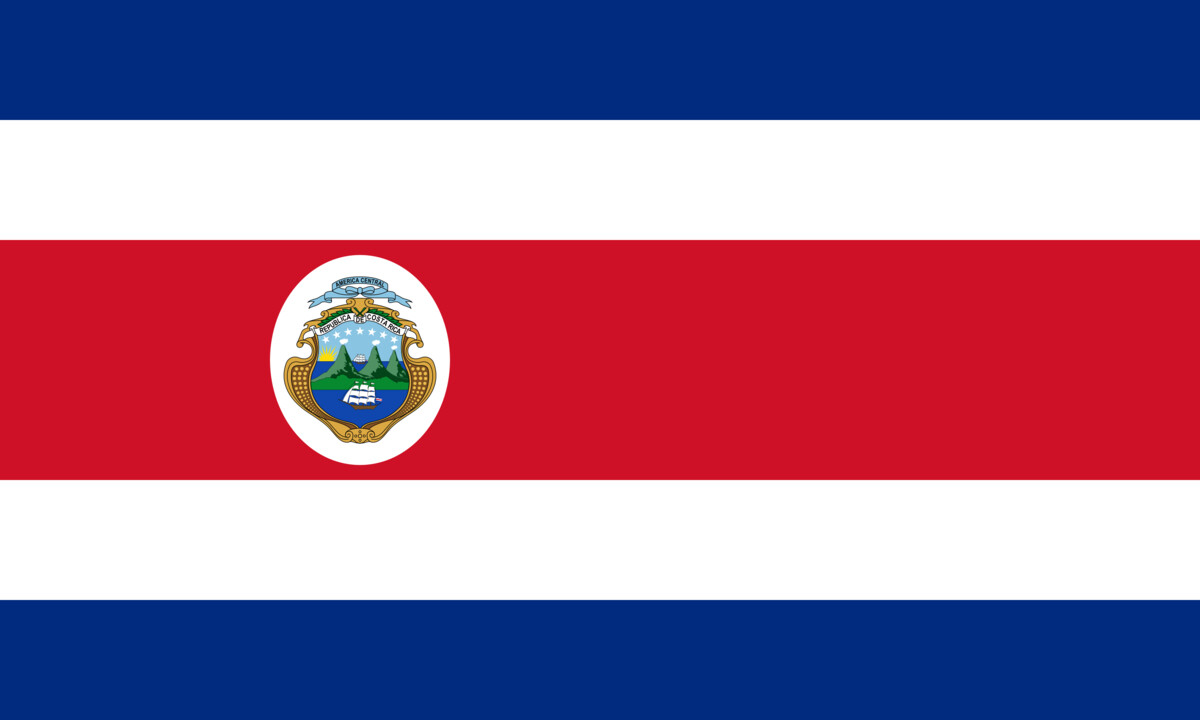
The flag of Costa Rica consists of five horizontal stripes: blue (top), white, red (center, double width), white, and blue (bottom). The central red stripe is twice as thick as the others, symbolizing strength and unity at the core of the nation. The legally observed size is 2.0 m long by 1.2 m high (a 5:3 ratio), and reductions or enlargements must maintain these proportions.
Two Official Versions of the Flag
Many people are surprised to learn that Costa Rica actually has two official versions of its national flag, each used for a different purpose:
- State Flag (Pabellón Nacional): This version includes the national Coat of Arms, placed inside the red stripe toward the hoist (left side). It is used by government institutions, embassies, and during official ceremonies.
- Civil Flag (Bandera Nacional): This version does not include the Coat of Arms and is the one most citizens display in homes, schools, or businesses.

Both flags share the same color pattern and proportions. The difference lies in the presence of the Coat of Arms, symbolizing Costa Rica’s sovereignty and authority when used by the state.
Does the Costa Rica flag have the Coat of Arms? The answer depends on the context. The state flag includes the Coat of Arms, while the civil flag does not. Both are official and recognized under Costa Rican law.
Flag Specifications (per current law)
- Ratio: 3:5 (height to length) — legally observed dimensions 1.20 m × 2.00 m
- Stripe proportions: 1:1:2:1:1 (red stripe double width)
- Colors: Blue Pantone Reflex Blue, White, Red Pantone 485 C
- Coat of Arms on state flag: Three volcanoes and a valley between two oceans with merchant ships; seven stars for the provinces (Alajuela, Cartago, Guanacaste, Heredia, Limón, Puntarenas, and San José); rising sun; “República de Costa Rica” ribbon (official model established by decree).
The Meaning Behind the Costa Rica Flag Colors
Each color in the Costa Rica flag carries deep symbolic meaning, reflecting the spirit of the nation and the character of its people.
Blue
Blue represents the sky, opportunities, perseverance, and Costa Rica’s idealism. It also symbolizes peace and the pursuit of happiness — qualities often celebrated by expats who relocate for the nation’s “Pura Vida” lifestyle and strong community life in towns like Playas del Coco (learn what day-to-day living looks like).
White
White stands for peace, wisdom, and freedom. Costa Rica abolished its military in 1949, and this commitment to peace is mirrored in the purity of the flag’s white stripes.
Red
Red symbolizes the warmth and generosity of Costa Ricans, the love of life, and the blood shed for freedom. Positioned at the center, the red stripe binds the other colors, embodying unity and passion.
The Costa Rica Coat of Arms Explained
When displayed on official flags, the coat of arms adds rich detail to the flag’s symbolism. The emblem features three volcanoes and a lush valley between two oceans, representing the country’s geography and its access to both the Pacific Ocean and Caribbean Sea.

- Ships: Represent Costa Rica’s maritime history and trade.
- Volcanoes: Symbolize the nation’s mountainous landscape.
- Seven Stars: Stand for Costa Rica’s seven provinces (Alajuela, Cartago, Guanacaste, Heredia, Limón, Puntarenas, and San José).
- Rising Sun: Reflects the promise of a bright future.
- Blue Ribbon: Bears the words “America Central”
- White Ribbon: Bears the words “República de Costa Rica”
When Was the Costa Rica Flag Adopted?
The flag was first raised in 1848 when Costa Rica declared itself a sovereign republic. The final official version, with the coat of arms standardized, was adopted in 1906. Subsequent reforms (notably in 1964) updated the coat of arms (e.g., seven stars for seven provinces), and a 2022 law consolidated usage rules and technical color specs.
How the Costa Rica Flag Is Used Today
The Costa Rica flag is prominently displayed in homes, schools, public institutions, and national celebrations. It flies proudly on Independence Day (September 15) and during civic parades known as “Desfiles Patrios.”
When used by government agencies, the flag always includes the coat of arms. Civil versions, seen on private property or during cultural events, are simpler — yet equally revered.
Respect and Flag Etiquette (legal highlights)
- Raise at 06:00 and lower at 18:00 with due respect, per current law.
- Government entities must display the flag with preference in interiors and exteriors.
- Damaged or faded flags should be respectfully retired and never used for commercial purposes without authorization.
Comparing the Costa Rica Flag With Other Latin American Flags
At first glance, the Costa Rica flag resembles that of Thailand — both have red, white, and blue horizontal stripes. However, Costa Rica’s design precedes Thailand’s by over 30 years. Its symbolism also differs greatly, rooted in the Enlightenment ideals of liberty and republicanism.
Within Central America, the Costa Rican flag stands apart for including red, distinguishing it from the blue-and-white designs of neighboring countries like Honduras and Nicaragua, which were derived from the old Federal Republic of Central America flag.
FAQs About the Costa Rica Flag
What does the Costa Rica flag represent?
The Costa Rica flag represents freedom, peace, and the unity of its people. Its colors express the nation’s optimism, purity, and courage.
What do the colors of the Costa Rica flag mean?
Blue symbolizes the sky and perseverance, white stands for peace and wisdom, and red represents courage and love for the nation.
Does the Costa Rica flag have the Coat of Arms?
The official state flag includes the Coat of Arms, while the civil flag does not. Both are legal national flags, used in different contexts — the former by the government, the latter by citizens.
When was the Costa Rica flag adopted?
The flag was officially adopted in 1906 (based on the 1848 design created by Pacífica Fernández Oreamuno), with later updates to the coat of arms and usage regulations.
What is the difference between the civil and state flags of Costa Rica?
The civil flag lacks the coat of arms, while the state flag includes it on the red stripe near the hoist. Both are official representations of Costa Rica.
Thinking About Life Under the Flag?
If the Costa Rican spirit resonates with you, see what moving entails in our practical guide to moving to Costa Rica. It covers neighborhoods, paperwork, and how to settle into daily life.
Sources & Legal References
- Ley 10178 (2022): Regula el uso del Pabellón, la Bandera y el Escudo Nacionales — incluye colores (Reflex Blue y 485C), horarios y uso
- Norma histórica sobre el Pabellón Nacional (definición de franjas 1:1:2:1:1)
- Decreto “Modelo Oficial del Escudo Nacional” (especificaciones del escudo)
- Comunicado de Presidencia (abril 2022): firma de la Ley 10178 y alcance
Fun Facts About the Costa Rica Flag
- Costa Rica’s flag was designed by a woman — Pacífica Fernández Oreamuno — a rare fact for 19th-century national symbols.
- The red stripe is intentionally twice the width of the others to symbolize the strength of the people’s spirit.
- Schools across the country hold special flag ceremonies every Monday to honor national values.
- The Costa Rican flag has remained virtually unchanged for over a century, a point of pride for many citizens.
Final Thoughts
The flag of Costa Rica is far more than a colorful emblem — it’s a living representation of the nation’s peace, democracy, and optimism. From the bold red that binds the colors to the peaceful blue skies it celebrates, every detail tells a story of unity and resilience. Whether you spot it waving over a school, a government building, or a family’s balcony, the Costa Rica flag remains a symbol of pride for Ticos everywhere.